

South Korea Crypto Exchange Restrictions: What to Know
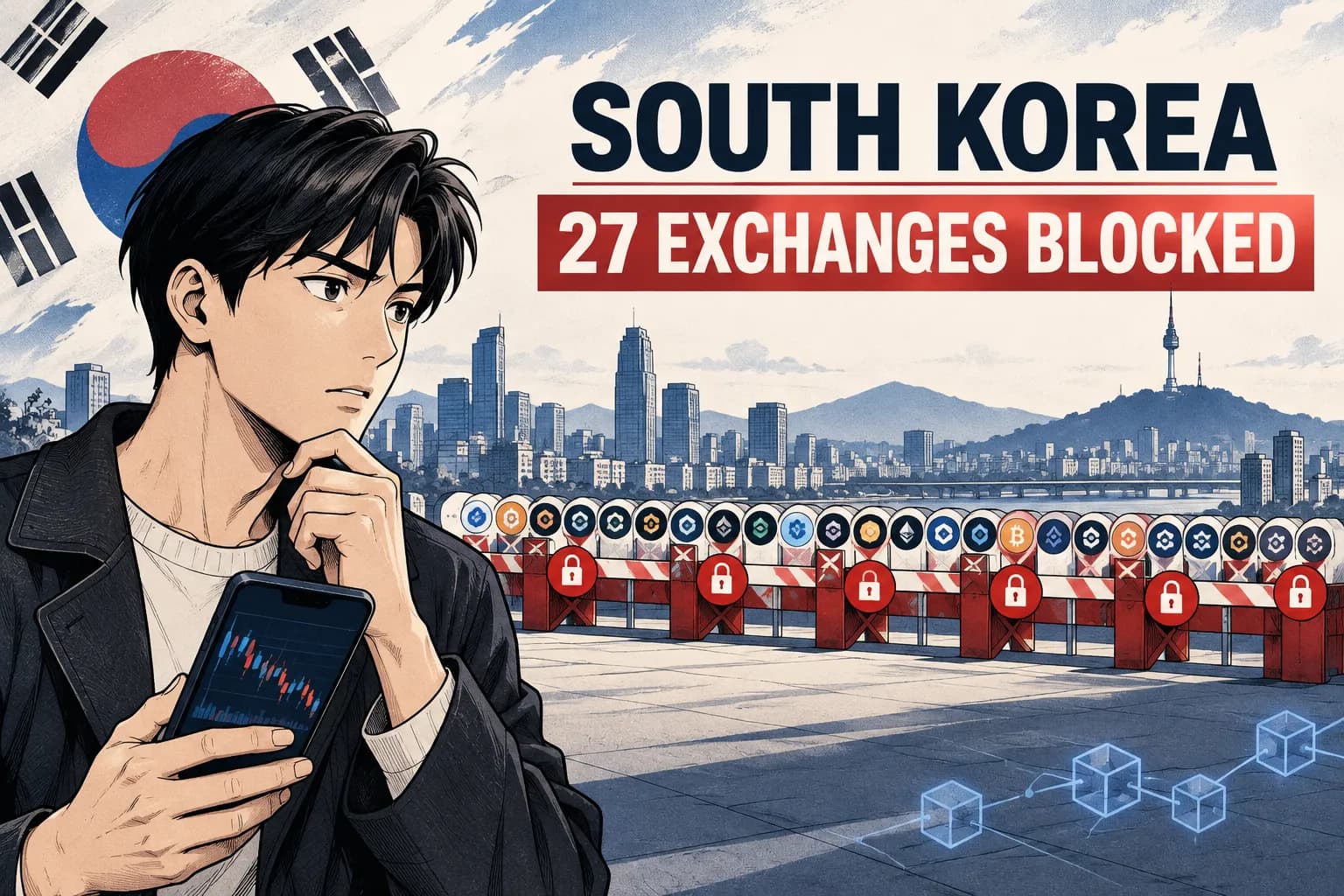
South Korea’s Financial Intelligence Unit (FIU) is reported to have blocked access to 27 unregistered offshore cryptocurrency exchanges, including KuCoin and MEXC. The action concerns services alleged to have operated without the required local registration; it does not, by itself, establish that those companies have been shut down globally or that customer assets have been frozen.
For users, the immediate question is less about the headline than about practical access: Can you log in, withdraw, and verify your holdings? Here is what the reported measure may mean, what remains important to confirm, and how investors can plan for different outcomes.
What South Korea crypto exchange restrictions mean for users
The reported measure targets access to exchanges in South Korea, not necessarily the exchanges’ operations worldwide. A domestic access restriction can affect a website, app, or other route available to users in the country, while the platform may continue serving customers elsewhere. The precise implementation and scope matter, so users should consult official notices and exchange communications rather than infer details from a headline alone.
The reported list includes KuCoin and MEXC, alongside 25 other offshore platforms. Without a verified official notice and complete list, investors should not assume that every service, subsidiary, app, domain, or product is affected in the same way. Nor should a named exchange’s inclusion be treated as evidence of a criminal finding; the issue described is local registration status.
A restriction on access is also different from a direct order to return customer funds. It may create practical obstacles to signing in or using a service from a particular jurisdiction, but it does not automatically tell us whether withdrawals remain available, whether accounts are being closed, or how a customer dispute would be resolved. Those details require confirmation from the regulator and the platform.
For anyone holding assets on an affected exchange, take a calm, documented approach:
- Check the exchange’s official notices and account-status page using verified channels.
- Confirm whether deposits, trading, and withdrawals are available in your location; do not rely on old help pages.
- Save account statements, transaction IDs, wallet addresses, and support correspondence.
- Review the platform’s withdrawal and identity-verification requirements before taking action.
- Avoid unsolicited “recovery” services, impersonator accounts, and links sent through direct messages.
Do not rush into a withdrawal simply because a headline is circulating. Network fees, withdrawal limits, asset availability, and the risks of sending funds to an incorrect address still apply. If you choose to move assets, first confirm the network and destination address with a small test transfer when appropriate, and keep records of the transaction.
Why South Korea FIU blocks offshore crypto platforms
South Korea regulates virtual-asset service providers under its financial-information framework, including the Act on Reporting and Using Specified Financial Transaction Information. In broad terms, businesses providing covered services to customers in the country may be required to report to the Korea Financial Intelligence Unit (KoFIU) and meet relevant anti-money-laundering obligations. Requirements can depend on the business model and the services offered.
Registration is not the same as a guarantee that an exchange is safe, profitable, or free from operational risk. It is a regulatory requirement, while customers must still assess custody practices, cybersecurity, liquidity, governance, and the terms that apply to their accounts. The distinction is important: a platform’s lack of local registration does not, on its own, prove that it has misused customer funds.
Foreign platforms that serve residents can face compliance questions even when their corporate headquarters and infrastructure are located outside South Korea. Regulators may focus on whether a provider is effectively offering services in the local market and whether it has met the reporting and customer-protection requirements that apply there. The specific legal basis and process for this reported block should be checked against the official notice.
This broader pattern is not unique to South Korea. Enforcement and registration standards vary by jurisdiction, and the consequences can range from warnings and restrictions to penalties or other legal action. ValorisVisio’s coverage of Germany’s exchange crackdown offers another example of how local rules can affect the availability of crypto services without necessarily ending a company’s global operations.
The regulatory distinction also helps explain why some exchanges may remain available to users in one country while limiting services in another. For context on licensing and compliance expectations, see our report on FCA crypto registration, which describes how registration standards can shape access in a separate market. The rules are not identical, but the investor takeaway is similar: check which entity serves your account and which jurisdiction’s protections apply.
South Korea’s exchange block and investor risks
The most direct risk for customers is disrupted access. If a person cannot reach a platform through their usual route, they may have difficulty checking balances, placing orders, or contacting support. Whether that risk is temporary or ongoing depends on the actual restriction, the exchange’s response, and the availability of legitimate account-access channels.
There is also a custody risk whenever assets are held on a centralized exchange. Customers generally depend on the platform to safeguard assets and process withdrawals under its terms. A regulatory access block does not prove insolvency, but it is a reason to review how much of a portfolio depends on a single provider and whether the holder has an independent record of balances and transactions.
A third concern is liquidity and execution. If local users are unable to trade on a particular venue, they may have to use another compliant platform, wait, or change their trading plan. Moving quickly between venues can involve spreads, fees, withdrawal delays, tax-record complexity, and price changes; it should not be treated as a risk-free substitution.
There may also be scams that exploit uncertainty. Fraudsters can imitate exchange support teams or claim they can bypass restrictions, unlock accounts, or recover funds for an upfront payment. Use contact information obtained directly from the platform’s verified website or app, and never share a seed phrase, password, or one-time authentication code with someone claiming to be support.
For investors comparing exchange and custody risk across countries, our coverage of global crypto regulations provides broader context on how firms navigate differing rules. Separate questions about custody are also covered in our SEC custody rules guide, though U.S. proposals should not be confused with South Korean requirements.
These risks are reasons to verify and plan, not a reason to assume every affected customer will lose funds. Avoid treating rumors about freezes, insolvency, or a forced shutdown as confirmed unless an official regulator statement or authenticated platform notice supports the claim. That distinction is especially important when information spreads rapidly on social media.
Practical steps for South Korea crypto exchange restrictions
Investors can turn the news into a manageable checklist rather than a prediction about market prices. Start by separating what is confirmed from what is still unknown: the reported number of platforms and named examples are part of the headline, while the exact effective date, technical blocking method, withdrawal status, and full platform list require reliable confirmation.
Then map exposure. Write down which assets are held on each exchange, whether they are spot holdings or products with additional counterparty risk, and what proportion of your crypto portfolio depends on that provider. Include open orders, staking or lending balances, and assets that may be subject to lock-up or withdrawal conditions.
A useful scenario framework has three cases:
| Scenario | What it could mean | Practical response | |---|---|---| | Access remains available | The reported measure has limited immediate effect on your account | Verify account status, keep records, and review local eligibility and platform terms | | Access or services are restricted | Some functions may be unavailable or altered for local users | Follow official instructions, document balances, and assess compliant alternatives without rushing | | Withdrawals are disrupted | You may be unable to move assets on your preferred schedule | Contact verified support, preserve evidence, avoid recovery scams, and seek qualified advice if a dispute develops |
This table is a planning tool, not a claim that any specific outcome has occurred. The right response depends on confirmed notices, the platform’s terms, the user’s location, and the assets involved. If you are unsure whether an action is permitted or how it affects your tax or legal position, consult a qualified professional in the relevant jurisdiction.
Investors should also distinguish exchange exposure from market exposure. A regulatory restriction can affect access to a venue, but it does not automatically predict Bitcoin’s or an altcoin’s price direction. Broader market sentiment, liquidity, interest rates, and asset-specific developments may matter more to price than a single access measure. For a wider view of how separate market forces can move prices, see our crypto market analysis.
To test your own thesis, compare scenarios rather than relying on one forecast. A simple portfolio calculation can estimate how different asset-price changes, portfolio allocations, or time horizons would affect a position; it cannot predict the outcome of a regulatory action or guarantee that an exchange will process a withdrawal. The free ValorisVisio calculator can help model those portfolio scenarios using assumptions you choose.
The central investor lesson is to reduce avoidable dependencies. Keep accurate records, understand the custody arrangement for each asset, and know which rules apply to the service you use. This does not mean every investor should move funds immediately; it means decisions should follow verified information and a clear assessment of personal risk.
Conclusion: South Korea’s reported action against 27 unregistered offshore crypto exchanges, including KuCoin and MEXC, makes local access and platform compliance worth checking, but it does not establish a global shutdown or frozen customer assets. Verify official updates, map your exchange exposure, and use the free ValorisVisio calculator to test portfolio scenarios before acting.
FAQ
Did South Korea block KuCoin and MEXC?
The reported action names KuCoin and MEXC among 27 offshore exchanges described as unregistered. Users should confirm the complete list, effective date, and scope through official South Korean notices and verified exchange communications. A domestic access restriction does not necessarily mean either platform has ceased operating globally.
Can South Korean users withdraw crypto from affected exchanges?
The headline alone does not confirm whether withdrawals are available, limited, or suspended for any particular exchange. Check the platform’s current official notice and account interface, and save relevant records. Do not use unofficial links or pay a third party claiming it can unlock or recover assets.
Does the South Korea FIU action mean customer funds are frozen?
Not necessarily. Blocking access to a service and freezing customer assets are different actions, and the reported headline does not establish that funds were frozen. Confirm any account or withdrawal restriction directly with the exchange and relevant authorities before relying on claims circulating online.
What should investors do if they hold crypto on an affected exchange?
First verify whether the platform and your account are affected, then document balances, open positions, and transaction history. Review official withdrawal instructions and applicable terms before making a move. Consider custody concentration and seek qualified legal or tax advice if access is restricted or a dispute arises.