


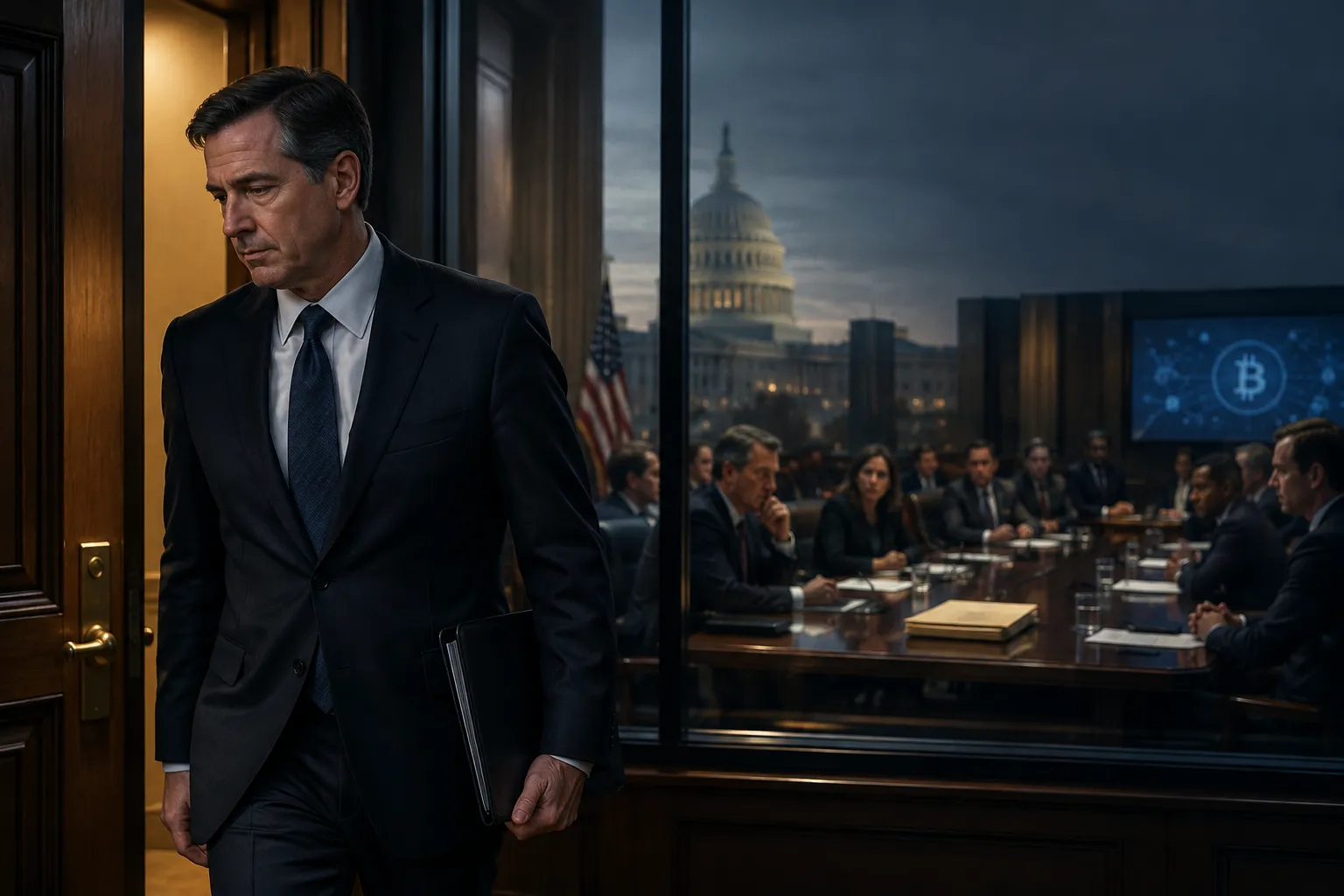
Patrick Witt Exit: Clarity Act Stall Explained
The reported departure of White House crypto adviser Patrick Witt comes as the CLARITY Act remains stalled, adding uncertainty to an already difficult U.S. market-structure debate. His exit does not automatically change existing law or prove the bill is dead, but it may complicate coordination and investor expectations while lawmakers decide whether and when to resume work.
That distinction matters: crypto markets often price expectations before legislation is enacted. For investors, the key question is not simply whether Witt has left, but whether the change alters the odds, timing or substance of a federal framework for digital assets.
Patrick Witt exit and the stalled CLARITY Act: what is known
The headline combines two developments: reporting that Patrick Witt is exiting his White House crypto adviser role, and continued delay around the Digital Asset Market Clarity Act, commonly called the CLARITY Act. As of October 16, 2026, the important policy fact is that the bill has not become law; the adviser’s departure does not itself enact, repeal or amend any statute.
The public record should be read carefully. A staff departure can signal a change in personnel or administration priorities, but it is not proof of a particular policy dispute, a planned reversal, or the reason for the departure unless those details are confirmed by reliable public statements. Investors should avoid treating speculation about the circumstances as established fact.
The CLARITY Act is intended to address a central U.S. crypto policy question: how responsibilities for digital-asset markets should be divided among federal regulators, including the Securities and Exchange Commission (SEC) and Commodity Futures Trading Commission (CFTC). A clearer framework could affect how firms classify assets, register activities and decide where to launch or expand products. The exact consequences depend on final legislative language, implementation and later regulatory rules.
A Senate effort to advance the measure failed to make progress, as covered in ValorisVisio’s report on the September cloture vote. That setback is a procedural obstacle, not necessarily a permanent end to the bill. Further action would require lawmakers to find a route forward, whether through renewed negotiations, a revised proposal, another legislative vehicle or a future session.
Witt’s role matters because White House advisers can help connect policy discussions across the executive branch and Congress. They may coordinate views, communicate priorities and support negotiations, but they do not pass legislation or independently set binding regulatory rules. The Patrick Witt exit, therefore, is best understood as a potential change in the policy process—not a direct change in the legal status of Bitcoin, Ether or other tokens.
What the Patrick Witt departure means for U.S. crypto regulation
The immediate effect is uncertainty about continuity. A departing adviser can leave open questions about who will handle coordination, whether another official will take over the portfolio, and whether the White House will continue to prioritize market-structure legislation. Until a successor, revised mandate or public policy statement is confirmed, those are questions rather than settled outcomes.
The broader debate also has several separate tracks. Congress considers legislation; federal agencies interpret and enforce existing law; and courts resolve disputes brought before them. A pause in one bill does not freeze all those processes, and agencies may continue rulemaking or enforcement under their existing authorities. For a related view of the regulatory implications, see ValorisVisio’s analysis of CFTC rules after the CLARITY Act stall.
For companies, the cost of delay can be practical as well as political. Unclear or changing requirements may influence whether a firm offers a product in the United States, how it structures a token or trading venue, what disclosures it provides, and how much it spends on legal and compliance work. These are business-planning considerations, not proof that every firm will move operations or that every token faces the same regulatory risk.
For investors, the law’s uncertainty is one input among many. A token’s valuation can also respond to interest rates, liquidity, network use, supply changes, earnings or revenue expectations, security incidents and broader risk appetite. A Patrick Witt exit may draw attention to policy risk, but it cannot by itself explain a price move across an entire market.
A useful way to separate signal from noise is to ask:
- What changed in law? Has a bill passed, been signed, or been replaced by a binding rule or court decision?
- What changed in process? Is there a scheduled hearing, a new sponsor, a committee action or a confirmed negotiating framework?
- What changed in implementation? Have regulators issued guidance, opened a rulemaking or changed an enforcement position?
- What is only commentary? Are claims about motives, successors or imminent passage supported by primary statements, or are they market speculation?
That checklist helps prevent a personnel headline from being mistaken for a regulatory event. It is especially relevant when policy commentary spreads quickly on social media and traders react before the underlying details are verified.
CLARITY Act uncertainty, crypto prices and investor positioning
The market effect of the Patrick Witt exit is not mechanically bullish or bearish. If investors interpret the departure as evidence that legislation is less likely in the near term, they may demand a larger discount for U.S. regulatory uncertainty, particularly for businesses whose models depend on clear asset classifications or exchange rules. If they expect a successor to maintain the same policy effort, the market response could be muted.
Even then, the effect will likely vary by asset and company. Bitcoin’s price is influenced by global liquidity, institutional demand and macroeconomic conditions as well as U.S. policy. Tokens connected to trading platforms, staking services, token issuance or DeFi may face more direct questions about regulatory treatment, but exposure differs by project and by the legal facts surrounding its activities.
Recent fund flows are a useful reminder that regulatory news competes with other market drivers. ValorisVisio reported Bitcoin ETF inflows of $103 million in an Uptober update; that figure is a dated snapshot, not a live measure for October 16 or a forecast of future demand. ETF flows can show institutional interest, but they do not establish that investors have priced in a particular legislative outcome.
Other sessions may show a different picture. The report on Bitcoin and Ether ETF outflows illustrates why investors should compare policy headlines with contemporaneous flows, market breadth and macroeconomic news rather than assigning a move to a single cause. For current decisions, verify the latest figures from the relevant fund issuers or market-data providers.
For portfolio positioning, the practical response is to manage uncertainty rather than bet everything on one legislative scenario. Investors might consider whether their holdings are concentrated in U.S.-exposed businesses, whether a thesis depends on rapid regulatory clarity, and whether a sudden shift in expectations would exceed their planned risk limits. These are general risk checks, not individualized investment advice.
A scenario-based approach can help make those checks concrete:
| Scenario | Possible market interpretation | Investor question | |---|---|---| | A successor continues the policy effort | The personnel change may be viewed as limited if legislative discussions resume | Which holdings rely on an eventual U.S. framework, and how long can the thesis tolerate delay? | | Negotiations remain stalled | Regulatory uncertainty may persist, with uneven effects across sectors | Is the portfolio diversified across assets, business models and jurisdictions? | | A revised bill or compromise advances | Expectations may shift before the final rules are known | Could an initial rally overstate what the eventual text would actually change? | | No near-term legislative route emerges | Firms and investors may focus more on existing rules and agency actions | What disclosures, compliance changes or court decisions could matter in the meantime? |
The table describes possible interpretations, not price targets or predictions. Crypto assets can move sharply in either direction, and a legislative development that benefits one segment may create costs or uncertainty for another.
How to track the Patrick Witt exit and manage exposure
The most useful signals now are verifiable process updates, not rumors. Watch for an official statement identifying the next White House point person, public comments from relevant lawmakers, a scheduled committee event, new bill text, or a clear agency action. Each would provide more information than speculation about why Witt is leaving.
Track the legislative calendar alongside market indicators. Relevant measures include spot-market liquidity, volatility, trading volume, ETF creations and redemptions, and any material change in funding conditions. None proves that the market is reacting to the CLARITY Act, but a consistent timeline can help investors judge whether the policy story is coinciding with broader risk-on or risk-off moves.
It is also worth distinguishing an announcement from implementation. Even if lawmakers reach an agreement, legislation would need to advance through the required process and could still be amended. Agencies may then need to interpret or implement provisions, leaving a gap between a headline about a deal and concrete changes for exchanges, issuers or investors.
For a disciplined review, investors can write down three assumptions behind a crypto position: the expected policy environment, the time horizon for the thesis, and the loss or volatility level they can tolerate. Then test what would change if the bill is delayed another quarter, substantially revised, or replaced by agency guidance and court decisions. This turns the Patrick Witt exit from a headline into a prompt for explicit scenario planning.
Avoid making an allocation decision solely because a senior adviser is leaving. Personnel changes matter most when they are followed by observable shifts in policy priorities, negotiating activity or regulatory decisions. Until those signals appear, the careful conclusion is that uncertainty has increased around process and timing, while the legal framework remains governed by laws and rules already in force.
For market participants, the main takeaway is to separate legislative probability from portfolio exposure. The CLARITY Act’s delay can affect expectations, but investors still need to evaluate each asset’s fundamentals, liquidity, volatility and jurisdictional exposure on its own merits. No single bill—or adviser—removes the need for independent risk management.
ValorisVisio’s free calculator can help you model possible portfolio outcomes under different price scenarios rather than relying on a single forecast. Use the tools at ValorisVisio to compare potential gains and losses before changing your allocation.
FAQ
Why did White House crypto adviser Patrick Witt leave?
The available information establishes that Patrick Witt is exiting his White House crypto adviser role, but it does not by itself confirm his reason for leaving. Unless an official statement or reliable reporting provides more detail, claims about a policy dispute, personal decision or planned replacement should be treated as unverified.
Is the CLARITY Act dead after the Senate stalled it?
No. A stalled Senate effort means the bill has not advanced through that route at that time; it does not prove the legislation is permanently dead. Lawmakers could revisit negotiations, revise the text, use another legislative vehicle or take up the issue in a later session.
Could the Patrick Witt exit affect Bitcoin or crypto prices?
It could influence sentiment about the timing of U.S. crypto rules, but it does not determine prices on its own. Bitcoin and token valuations also respond to liquidity, rates, fund flows, network conditions and risk appetite. Check current market data before attributing a move to this personnel change.
What should crypto investors watch after Patrick Witt’s departure?
Look for a confirmed successor or policy statement, renewed CLARITY Act negotiations, committee activity, new bill text and relevant agency actions. Compare those developments with current ETF flows, volatility and macroeconomic conditions. Distinguishing confirmed events from speculation can help investors avoid overreacting to headlines.